Case study · Retention
Bank Customer Churn
€186M of deposits sitting with customers likely to leave.
- Scale
- 10,000 customers · France, Germany, Spain
- Role
- Sole analyst — raw extract to dashboard
Context
A retail bank with a €765M deposit book across France, Germany and Spain wanted to know how much of it was at risk, and where to spend a retention budget.
Churn is usually reported as a percentage of customers. I measured it in euros of deposit instead, because the customers most likely to leave don’t hold average balances.
The data
A public dataset of 10,000 retail-banking customers across three markets. One row per customer: balance, tenure, number of products held, an activity flag, and whether they left.
Churn runs at 20.4%, so predicting “nobody leaves” scores 79.6% accuracy. That’s the baseline anything here has to beat.
Approach
I cut the deposit total by market, products held, balance band and activity. Two of those cuts did the work.
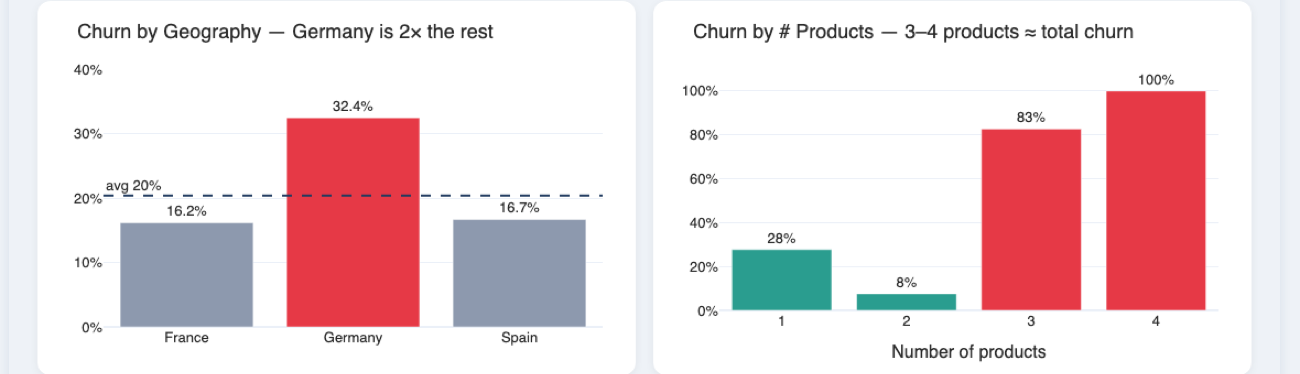
Germany churns at 32.4%, against 16.2% in France and 16.7% in Spain — double the rest on a similar customer base, which points at something specific to that market.
Products held run the other way, and harder: 28% at one product, 8% at two, then 83% at three and 100% at four. Two products looks like the healthy state.
Result
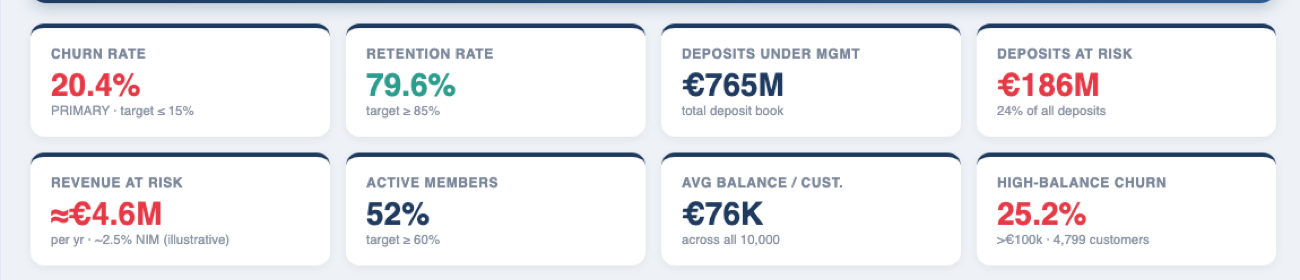
20.4% churn, €186M of deposits at risk — 24% of a €765M book — and roughly €4.6M of annual revenue behind it.
The 4,799 customers holding more than €100,000 churn at 25.2%, so the deposit book leaks faster than the customer count suggests.
I’d start with Germany, then look at what happens to customers who end up holding three or more products — that group churns almost completely.
The €4.6M revenue figure applies an illustrative 2.5% net interest margin, not the bank’s real one. The three- and four-product groups are small, so 83% and 100% are directional.